
Tools
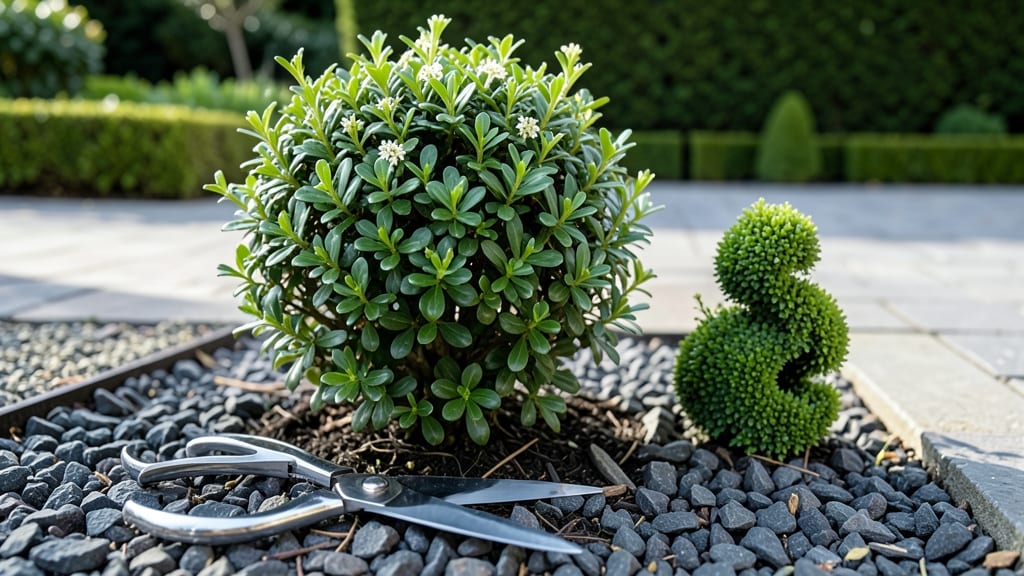
A small formal garden transforms tight spaces into refined outdoor rooms through precise geometric layouts, mirror-like plant pairings, and clean-lined hardscapes like clipped boxwood alleys or gravel pathways. Prioritize evergreen shrubs and slow-growing perennials to reduce maintenance while preserving that crisp, curated look.
Creating a small formal garden isn't about sacrificing style for space—it's about working with what you have.
The secret lies in axial symmetry, where every plant and path has a deliberate counterpart, making even a 4x6-foot area feel grand. 🌿 I've seen homeowners use dwarf conifers as vertical accents along narrow borders or lavender hedges to frame entryways, both of which stay compact while delivering year-round structure.
The key is editing ruthlessly: fewer plants in tighter formations create more impact than crowded beds.
For hardscapes, think proportional geometry—a 3-foot-wide gravel path feels intentional next to a 2-foot boxwood hedge, while a single ornamental urn at the garden's center anchors the composition.
Even in urban courtyards, you can achieve this look by using raised planters with topiary or repeating herbaceous perennials like salvia in symmetrical clusters. The result? A space that feels both intimate and intentionally designed.
💡 In This Article
- Key Elements of Formal Garden Design for Compact Spaces
- Top Space-Saving Plants for Formal Garden Borders
Key elements of formal garden design for compact spaces
Formal gardens rely on axial symmetry, where every element has a mirror image across a central axis—think of a perfectly clipped boxwood hedge flanking a gravel path. In small spaces, this principle works best when scaled down: a 3-foot-wide path paired with 2-foot-tall hedges creates proportional harmony.
The human eye perceives balance when vertical and horizontal elements align mathematically, so measure your space first. For example, a 4x6-foot garden might feature two 1-foot-wide lavender bushes on either side of a 2-foot central urn, with a 1-inch gravel path connecting them.
This creates visual weight without overwhelming the area. 🔥
The layered planting scheme is another game-changer for compact formal gardens. Start with a tall structural plant (like a 3-foot dwarf conifer) at the back, then add medium-height shrubs (such as 2-foot boxwood) in the middle, and finish with low-growing perennials (like 6-inch thyme) at the front.
This creates depth perception, tricking the eye into seeing more space than exists. Color contrast also matters: pair a silver foliage plant (like lamb's ear) with a deep purple flower (like salvia) to make each element pop against its neighbors.
The science here is about visual weight distribution—lighter colors and textures (like feathery grasses) should balance bolder forms.
Focal points anchor the design and draw the eye. In a small formal garden, these can be surprisingly modest: a single ornamental urn filled with boxwood topiary, a statue no taller than 2 feet, or even a geometric metal sculpture placed at the garden's center.
The rule is to keep the focal point no more than 30% of the garden's width to avoid visual clutter. For instance, in a 5x5-foot space, a 1.5-foot-tall obelisk would work perfectly. These elements should also align with the garden's central axis to reinforce symmetry. 💫
Hardscapes like paths and edging define the structure of a formal garden. Use materials that complement the scale: gravel paths no wider than 18 inches feel intentional, while narrow metal or stone borders (like 2-inch-wide edging bricks) create clean lines.
The texture contrast between smooth gravel and the rough bark of a boxwood hedge adds visual interest without taking up space. For urban areas, consider raised planters with formal edges—these can house clipped topiary or symmetrical herb arrangements while keeping soil contained.
The key is to let the hardscapes guide the eye along the garden's axis, reinforcing the formal structure.
Plant selection is critical for low maintenance. Opt for slow-growing perennials (like lavender, which grows only 6-12 inches per year) and evergreen shrubs (such as boxwood, which stays compact at 2-3 feet tall when pruned). These plants require minimal pruning and retain their shape year-round.
Avoid fast-growing species like bamboo, which can quickly overwhelm a small space. Instead, choose plants with seasonal interest: for example, ornamental grasses provide winter texture, while spring bulbs (like daffodils) add early color. This ensures your garden remains visually engaging with minimal effort. ✨
Finally, lighting can elevate a small formal garden by highlighting key elements. Install small uplight fixtures (like 3-inch spotlights) to illuminate focal points at night, or use solar-powered path lights spaced 2 feet apart along gravel paths.
The warm glow of 2700K bulbs creates a cozy atmosphere while emphasizing the garden's symmetry. Just be mindful of scale—overly bright or large fixtures can disrupt the delicate balance of a compact space. 🌟