
Container Gardens
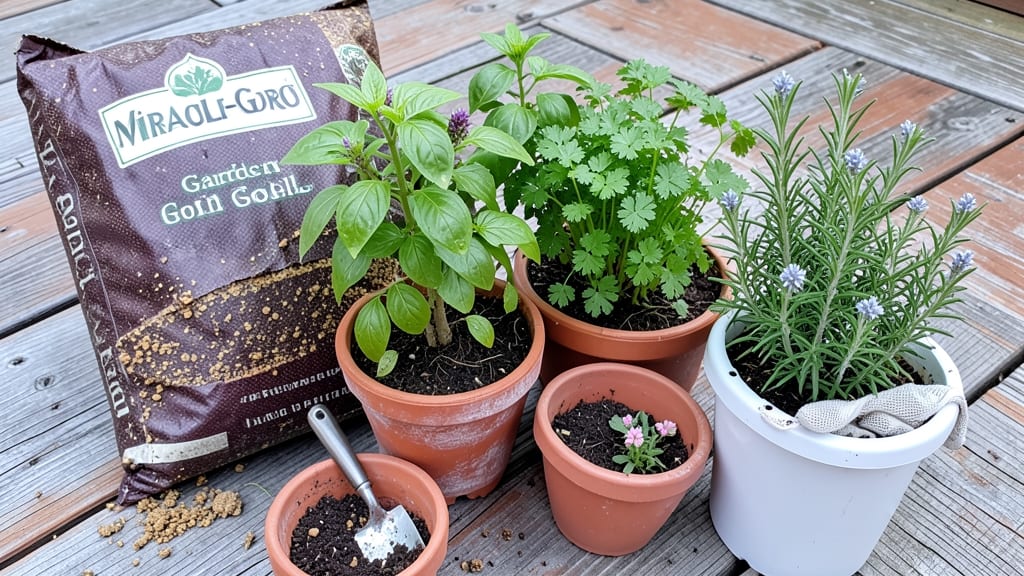
You can use Miracle-Gro Garden Soil in containers, but it needs adjustments to prevent compaction and improve airflow, since its dense mix can restrict root growth in confined spaces. Blend it with perlite or coarse sand for better drainage and aeration.
Miracle-Gro Garden Soil is designed for in-ground planting, where its nutrient-rich blend works well over larger areas. 🌱 In containers, though, the lack of natural soil movement and limited space means roots can’t expand properly, leading to poor drainage and potential rot.
I’ve found that adding 20-30% perlite or vermiculite by volume creates air pockets while maintaining moisture retention—critical for container plants like herbs or lettuce. For heavy feeders like tomatoes, consider mixing in a slow-release fertilizer to compensate for the soil’s initial nutrient boost wearing off faster in pots.
Another key adjustment is container size: smaller pots dry out quicker, so I always use at least a 12-inch diameter for most plants. Drainage holes are non-negotiable—without them, even amended soil can become waterlogged.
For acid-loving plants like blueberries, you might need to add sulfur to adjust the soil’s pH, since Miracle-Gro’s blend tends to be slightly alkaline. The bottom line? With the right amendments, this soil can work beautifully in containers—but it’s not a plug-and-play solution.
💡 In This Article
- Miracle-Gro Garden Soil Composition for Container Gardening
- Best Ways to Modify Miracle-Gro Soil for Pots and Planters
Miracle-gro garden soil composition for container gardening
Miracle-Gro Garden Soil is formulated with a blend of 50% peat moss, 25% composted materials, and 25% controlled-release fertilizers designed to provide immediate nutrients.
The peat moss gives it moisture retention while the compost adds organic matter, but this combination creates a dense structure that works well in garden beds where roots can spread freely.
In containers, however, this density becomes problematic because roots have nowhere to expand, leading to compaction that suffocates them over time. 🌱
The soil’s 1-2% organic matter content (lower than ideal for containers) means it holds water tightly, increasing the risk of root rot in confined spaces. For comparison, ideal container mixes contain 30-40% organic matter to balance moisture and aeration.
The controlled-release fertilizers (like sulfur-coated urea) provide nutrients for 3-6 months, but in containers, these nutrients leach out faster due to frequent watering, leaving plants hungry sooner than expected.
What makes this soil particularly tricky in containers is its high bulk density—about 0.8-1.0 g/cm³—which means it compresses easily under plant weight and watering. In garden beds, this density helps retain moisture, but in pots, it creates airless pockets where roots can’t access oxygen.
This is why many container plants struggle with stunted growth or yellowing leaves when planted directly in unamended Miracle-Gro soil.
Another critical factor is the soil’s pH range of 5.5-7.0, which suits most common garden plants but may be too alkaline for acid-loving species like azaleas or blueberries (which prefer pH 4.5-5.5
In containers, where pH adjustments are harder to maintain, this can become a limiting factor for specific plant varieties. The lack of natural soil organisms (like earthworms) also means decomposition happens slower, reducing long-term soil health in confined spaces. For visual contrast, imagine pouring water into two containers: one with pure Miracle-Gro soil and one with a 50/50 mix of Miracle-Gro and perlite. The amended mix will drain 30-50% faster while still retaining enough moisture for roots. This structural difference is what transforms a potentially problematic soil into a workable container medium. The key is creating that balance between density and aeration that container roots desperately need.