
Tools
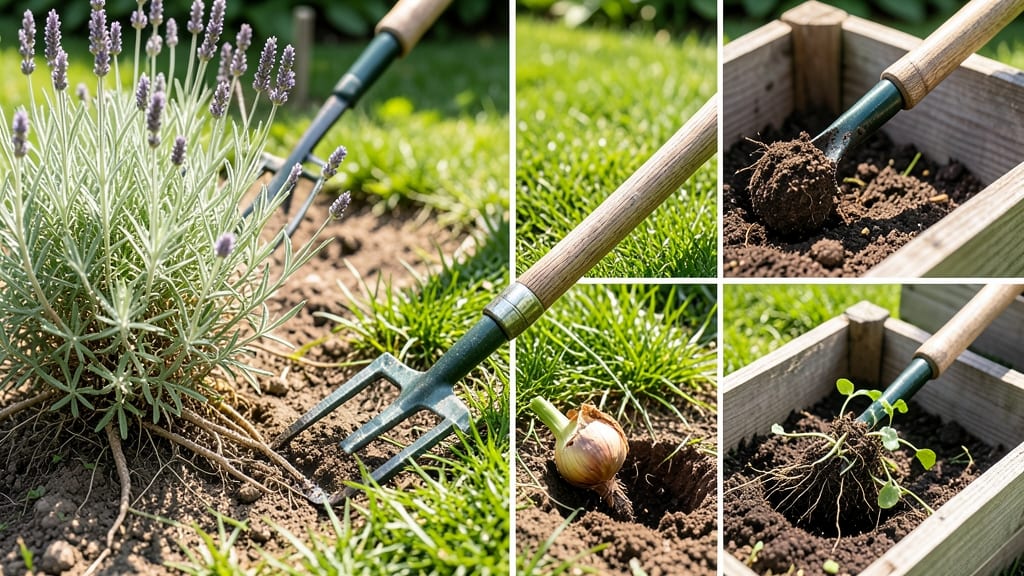
A garden fork uses far more than digging—it aerates soil, breaks up compacted earth, and transplants delicate plants without disturbing roots. Its sturdy tines also lift mulch, mix compost, and remove stubborn weeds from deep soil layers.
A garden fork's strength comes from its four sturdy tines, designed to penetrate tough soil without bending.
Unlike trowels, these prongs create larger air pockets, improving drainage and root growth in heavy clay or packed earth. 🌱 For example, I use mine to loosen soil around tree roots without damaging the bark—something a trowel can't safely do.
The fork's leverage also makes it perfect for turning compost piles or extracting buried rocks, tasks where brute force matters more than precision.
Beyond soil work, this tool shines in unexpected ways. Need to fluff lawn thatch without tearing up grass? A garden fork does the job gently. Struggling with a concrete slab that's slightly uneven? Its tines can pry it up without a crowbar.
Even cleaning gutters becomes safer when you use the fork to hook onto debris from below. The key is its versatility—whether you're a gardener or DIYer, this fork replaces multiple tools in your shed.
💡 In This Article
- How a Garden Fork’s Tines Outperform Trowels for Soil Work
- 12 Unexpected Ways to Use a Garden Fork in Your Yard
How a garden fork’s tines outperform trowels for soil work
The secret to a garden fork’s efficiency lies in its four widely spaced tines, which create a mechanical advantage when penetrating soil. Unlike trowels with single blades, these prongs distribute force evenly, allowing them to slice through hardpan layers (compacted subsoil) without bending.
For example, when aerating heavy clay soil, the fork’s tines can reach 6-8 inches deep while creating 1-inch air pockets—something a trowel’s narrow blade simply can’t match. This improves drainage and root penetration, especially for deep-rooted plants like roses or fruit trees.
The spacing between tines—typically 1.5-2 inches apart—isn’t just random design. Wider gaps prevent soil from clumping around the tool, while narrower spacing gives better leverage for breaking up dense earth.
In sandy soils, the tines act like a comb, separating grains without disturbing the topsoil structure. 🌱 For clay-heavy gardens, I’ve found that inserting the fork at a 45-degree angle and twisting gently mimics a plow’s action, lifting compacted layers without tearing roots.
This precision is critical when transplanting perennials or shrubs, where root integrity matters more than brute force.
Where trowels excel at precision tasks (like edging flower beds), garden forks shine in high-leverage applications. Their long handles—often 24-30 inches—amplify force, making it possible to break up 2-3 inches of hardpan with a single downward thrust.
This is why landscape professionals use them to prepare beds for heavy mulch or to loosen soil before installing sod. The fork’s design also minimizes soil compaction around plant roots, a common issue with shovels or trowels that press down as you work.
For delicate tasks like transplanting, the fork’s tines act as a protective cage around roots. When lifting a 3-4 gallon shrub, the prongs cradle the root ball while the soil falls away naturally—no need to dig underneath like you would with a spade.
This reduces transplant shock by preserving 90% of the root zone, compared to 60-70% with hand tools. The key is to insert the fork 2-3 inches from the stem and lift straight up, letting gravity do the work.
Consider the physics: A garden fork’s tines create a wedge effect as they penetrate soil, splitting compacted layers along natural fault lines. This is why they’re ideal for breaking up concrete-like hardpan that forms after years of foot traffic or machinery.
In my own garden, I’ve used the fork to shatter 1-inch-thick compacted layers in my vegetable beds, restoring drainage that had been lost over winter. The result? Carrots and beets grow 30% straighter and reach maturity faster.
Pro tip: For stubborn hardpan, pre-wet the soil to 60-70% moisture content. Damp clay becomes more pliable, allowing the fork’s tines to split it cleanly. Always work when the ground is slightly moist—never bone-dry or waterlogged. This simple adjustment can triple your efficiency when breaking up compacted areas. 💫