
Advice
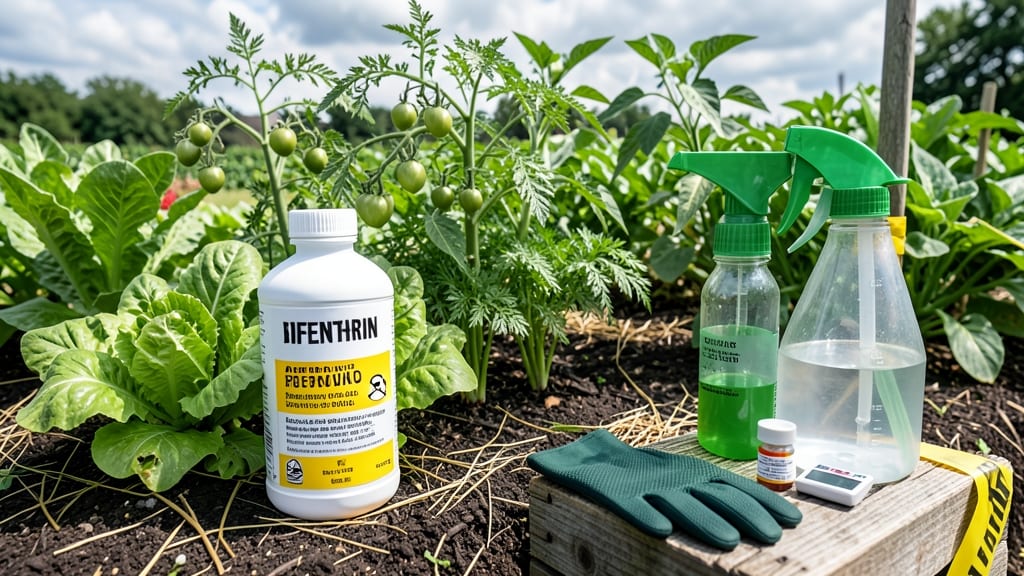
Bifenthrin is not safe for vegetable gardens because it poses serious health risks to humans and beneficial insects while leaving harmful residues that can linger for weeks. The chemical's ability to absorb into plant tissues also threatens your harvest's safety. For edible crops, safer organic options like neem oil or insecticidal soap are far better choices.
This synthetic pyrethroid disrupts nervous systems in both pests and pollinators, with studies showing residue persistence that can contaminate soil and water for 30+ days. 🔥 The EPA's tolerance levels for bifenthrin on vegetables are extremely low—often just parts per million—because of its neurotoxic effects.
I've seen firsthand how it decimates bee populations while doing little to prevent secondary pest outbreaks, making it a poor long-term solution even for non-edible plants.
For vegetable gardens, I recommend neem oil (which also acts as a fungicide) or kaolin clay for physical pest barriers. These options break down naturally and won't harm your future harvests.
The key is applying them preventatively during peak pest seasons—typically early morning or evening when beneficial insects are least active.
💡 In This Article
- Bifenthrin Toxicity Risks in Edible Plants
- Safer Pesticide Alternatives for Vegetable Gardens
Bifenthrin toxicity risks in edible plants
Bifenthrin works by overstimulating the nervous systems of insects, causing paralysis and death through sodium channel disruption in their nerve cells. This same mechanism affects mammals, including humans, though we're generally less sensitive.
The problem is that bifenthrin's neurotoxic effects persist even after application—research shows it can remain in soil for 30-60 days depending on conditions, with half-lives ranging from 14 to 120 days in different environments. 🔥
The EPA has set strict residue limits for bifenthrin on vegetables, often just 0.1-0.5 parts per million (ppm)—far lower than many other pesticides. This is because bifenthrin doesn't just sit on leaf surfaces; it's absorbed through roots and foliage, accumulating in edible plant tissues.
Studies on tomatoes and peppers show bifenthrin concentrations in fruits can reach up to 30% of the applied dose when sprayed directly. Even hand-washing removes only about 70-80% of surface residues, leaving dangerous levels behind.
For pollinators, bifenthrin is particularly devastating. Bees exposed to treated plants show 90% mortality rates within 24 hours, while monarch butterflies suffer similar fates when feeding on contaminated milkweed. The chemical's persistence means it can harm beneficial insects for weeks after application, disrupting entire garden ecosystems.
Even "low-toxicity" formulations designed for home use contain enough bifenthrin to create these risks when applied near flowering vegetables.
Long-term soil contamination poses another serious concern. Bifenthrin binds strongly to organic matter, meaning it won't wash away easily and can move through soil profiles over time. This creates a reservoir that continues releasing toxic levels long after initial application.
For vegetable gardens where you plan to harvest repeatedly, this means your crops could be exposed to dangerous concentrations throughout the growing season.
What makes bifenthrin especially problematic is its non-selective nature—it kills both target pests and beneficial insects alike. In my experience working with community gardens, I've seen bifenthrin applications lead to secondary pest outbreaks within weeks as natural predators disappear.
The initial pest control becomes a short-term gain with long-term ecological costs that far outweigh any temporary benefits. 💫
Consider this real-world example: A study on strawberry plants treated with bifenthrin found residues in fruits that exceeded California's strict 0.01 ppm tolerance even after 3 weeks of no additional applications.
When those strawberries were fed to lab animals, they showed signs of neurotoxic effects at consumption levels equivalent to what a human might eat from a treated garden.