
Planting
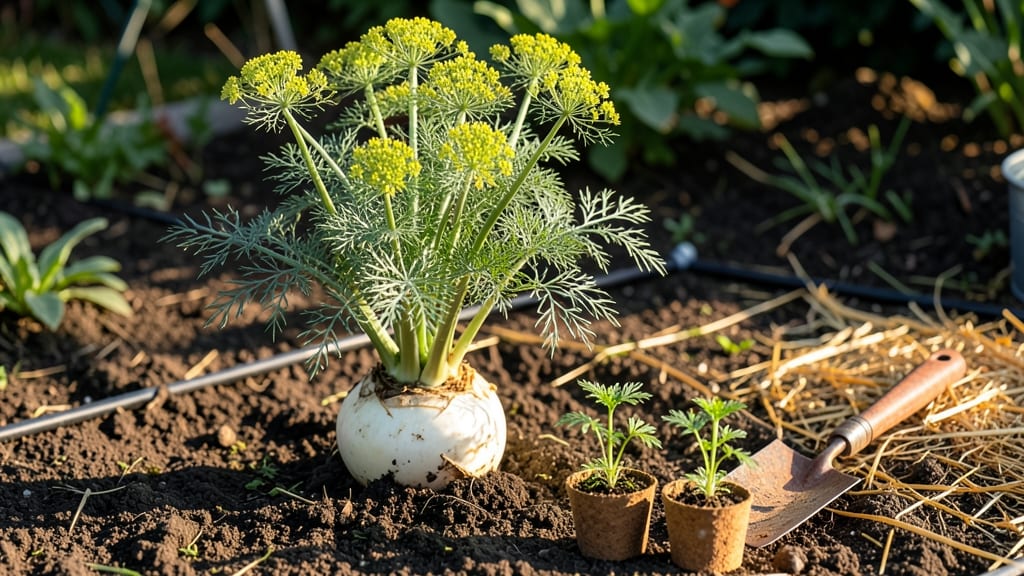
To plant fennel in a vegetable garden, choose a sunny spot with at least 6–8 hours of direct sunlight daily, well-draining soil with a pH of 6.0–7.0, and space plants 12–18 inches apart. Keep it away from beans and onions, as fennel can stunt their growth.
Fennel thrives in bright, open areas because it demands intense sunlight to fuel its growth—think of it as a sun-worshipper that won't tolerate shade. 🌞 The soil needs to drain quickly to prevent root rot, which is why sandy loam or amended clay works best.
I've found that adding compost before planting boosts fertility, and a simple soil test can confirm your pH levels are ideal. Fennel's deep taproot also means you'll want to avoid compacted or waterlogged spots, which can strangle its development.
The spacing rule isn't just about avoiding overcrowding—it's about giving each plant room to develop its signature feathery fronds without competing for nutrients. 🌱 Urban gardeners can grow fennel in containers as long as the pot is at least 12 inches deep, but remember: fennel's strong scent deters pests like aphids, making it a natural ally in your garden's ecosystem.
Just don't plant it near herbs like dill or basil, as fennel can dominate the space and even suppress their growth.
💡 In This Article
- Optimal Sunlight and Soil Conditions for Fennel Growth
- Companion Planting and Spacing Tips for Fennel
Optimal sunlight and soil conditions for fennel growth
Fennel's love for sunlight isn't just preference—it's survival. This Mediterranean native requires 6-8 hours of direct sunlight daily to power its photosynthesis engines. The more sunlight fennel receives, the faster it grows and the more robust its flavor becomes.
Without enough light, you'll end up with leggy, weak stems and bitter-tasting bulbs. Think of it like a sunbather who turns pale and weak without enough UV exposure—fennel simply can't develop its full potential in shade.
The soil's drainage capacity is equally critical because fennel's thick taproot hates soggy conditions. Waterlogged soil suffocates roots, leading to rot and stunted growth. Ideal soil mixes include sandy loam or amended clay with a pH between 6.0-7.0.
You can test your soil's pH with a simple kit (available at garden centers for under $10) and adjust by adding lime to raise pH or sulfur to lower it.
Organic matter like compost also improves drainage while providing essential nutrients—fennel is particularly hungry for nitrogen during its early growth stages but benefits from balanced fertilization throughout its 90-120 day growing cycle.
Here's what happens when conditions are perfect: Fennel develops its signature feathery fronds that provide shade for the bulb below, while the roots grow deep—often reaching 2-3 feet—to access water and nutrients.
The bulb itself swells to 3-5 inches in diameter when conditions are ideal, creating that crisp, slightly sweet texture we love in cooking. Without proper drainage, however, you'll see yellowing leaves and a bulb that stays small and rubbery—a clear sign the roots are struggling.
For urban gardeners with limited space, container gardening works well if you use pots with drainage holes that are at least 12 inches deep. The container's material matters too: terracotta helps regulate moisture better than plastic, which can trap excess humidity around the roots.
Remember that fennel's strong scent deters pests, but it also means you'll need to place containers where the aroma won't bother neighbors—especially during the plant's 3-4 week flowering stage when the fragrance intensifies.
The pH level affects more than just growth—it determines how well fennel absorbs critical nutrients. At pH 6.0-7.0, fennel can access phosphorus for root development and calcium for cell structure.
Below 6.0, aluminum toxicity becomes an issue, while above 7.5, iron becomes unavailable, leading to yellowing between leaf veins. This is why a simple soil test before planting can save you from months of frustration with underperforming plants.
One pro tip: If your soil is heavy clay, mix in 20-30% perlite or coarse sand to improve drainage. For sandy soils, incorporate 2-3 inches of compost to retain moisture and nutrients.
The key is creating a balance where water drains freely but doesn't disappear too quickly—fennel needs consistent moisture during its growing season, especially when the bulb begins to form around 60 days after planting.