
Tools
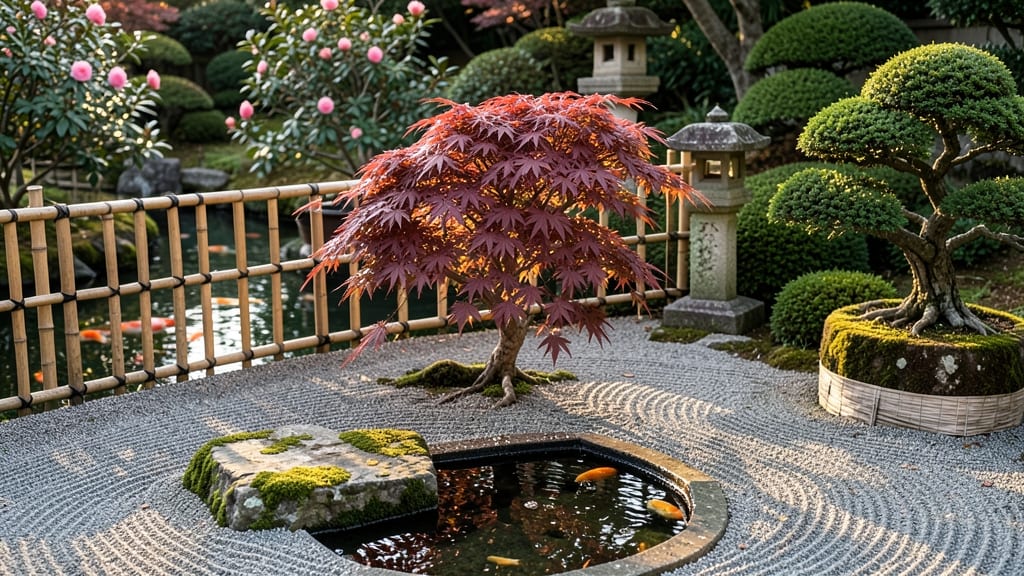
A Japanese garden in Los Angeles creates peaceful retreats by adapting traditional Japanese aesthetics to Southern California’s dry climate, showcasing koi ponds, carefully placed stones, and iconic trees like Japanese maples and azaleas. Two standout public gardens are Huntington Library’s meticulously designed Japanese Garden and Descanso Gardens’ serene Zen space.
Los Angeles’s Japanese gardens thrive by blending centuries-old traditions with local environmental realities. 🌿 The climate here demands drought-resistant plants like black bamboo and camellias, while the city’s urban setting allows for creative adaptations—like using water features sparingly to conserve resources.
These gardens don’t just look beautiful; they teach mindfulness through their carefully arranged elements, from raked gravel to strategically placed lanterns that guide visitors through meditative pathways.
What makes these spaces truly special is how they invite exploration beyond the main paths. At Huntington’s garden, for instance, you’ll find hidden corners with moss-covered rocks and miniature bridges that frame views of the surrounding landscape.
Meanwhile, Descanso’s Zen area offers a quieter experience with its dry riverbeds and stone seating designed for reflection. Both gardens serve as living classrooms for anyone interested in how traditional Japanese design principles can flourish in unexpected places.
💡 In This Article
- Design Principles Behind LA’s Japanese Gardens
- Hidden Gems: Best Japanese Gardens for Plant Lovers in LA
Design principles behind LA’s Japanese gardens
Japanese gardens in Los Angeles embody the core principles of wa (harmony) and yūgen (subtle grace), but with clever adaptations to Southern California’s Mediterranean climate. The most striking feature is the use of water—not just for aesthetics, but as a symbol of purity and flow.
Unlike traditional Japanese gardens that rely on abundant rainfall, LA’s versions incorporate drought-tolerant koi ponds with recirculating systems that minimize water waste. For example, the Huntington Library’s Japanese Garden uses a 15-foot-long pond fed by a closed-loop fountain, reducing evaporation while maintaining the serene sound of trickling water. 🌊
The placement of rocks and stones follows strict philosophical rules, often representing mountains or islands. In LA’s dry climate, gardeners select smooth, rounded stones like those from local quarries, which weather differently than volcanic rocks used in Japan.
These stones are strategically positioned to create visual balance—never in odd numbers—and often paired with bamboo (like Fargesia nitida) that thrives in LA’s mild winters.
The contrast between the organic curves of bamboo and the angularity of stones demonstrates fukinsei, or "imperfect perfection," a key Japanese design concept. 🌿
Plant selection is where LA’s gardens get particularly creative. Traditional Japanese gardens rely on species like maples and wisteria, but Southern California’s 100°F+ summers demand heat-resistant alternatives.
Gardeners here often use camellias (which bloom in winter), Japanese black pine (Pinus thunbergii), and California native companions like manzanita to create layered textures.
The Huntington’s garden, for instance, features a 200-year-old Japanese maple (Acer palmatum) that’s been pruned to withstand LA’s dry winds—a technique called yosegi, where branches are trained to grow in specific patterns. ✂️
Lighting plays a critical role in these gardens, especially during LA’s long evenings. Traditional stone lanterns (tōrō) are placed along pathways to guide visitors while creating a sense of depth.
However, modern LED versions are now used to conserve energy—like the solar-powered lanterns at Descanso Gardens, which mimic the glow of candlelight. The interplay of natural and artificial light enhances the yūgen effect, making spaces feel both timeless and alive. 🌙
What’s often overlooked is how these gardens incorporate soundscapes. The rustling of bamboo, the gentle splash of water, and even the distant hum of city traffic (softened by strategic plant placement) create a layered auditory experience.
At the Japanese Tea Garden at Descanso, visitors can hear the plink-plonk of a bamboo water feature while sipping matcha—a deliberate choice to reinforce the connection between nature and mindfulness. 🎶
For those curious about recreating these principles at home, start with three key elements: a focal point (like a stone or plant), a pathway (even a simple gravel strip), and negative space (areas left intentionally empty).
LA’s gardens prove that Japanese design isn’t about replication—it’s about adapting ancient wisdom to modern contexts with creativity and respect for the environment. 🌱