
Tools
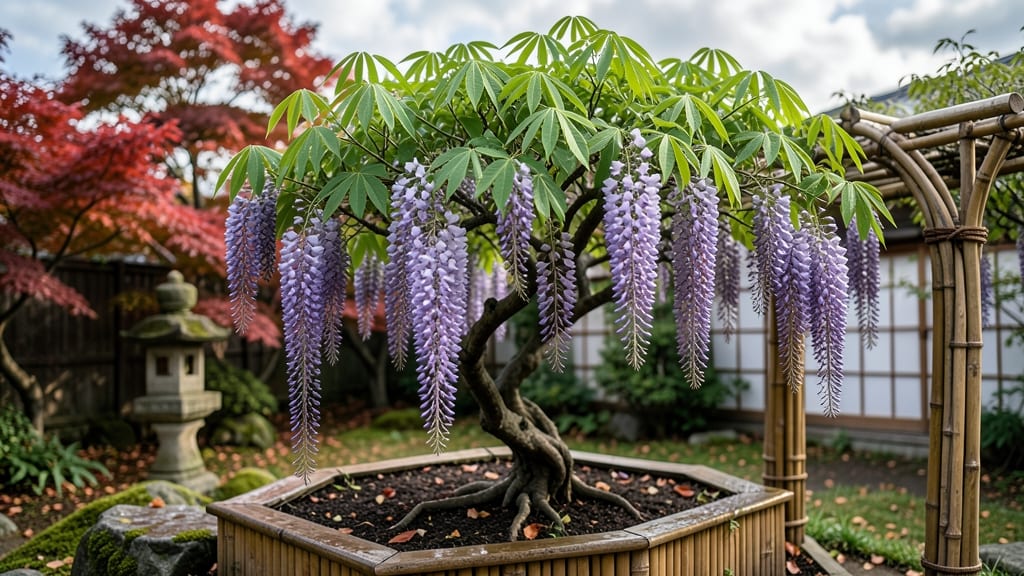
Wisteria in Japanese gardens represents elegance and endurance, commonly cultivated as decorative trellises or sprawling ground covers that burst into fragrant purple blooms each spring. Late-winter pruning is essential for maintaining vigorous growth and lush flowering, while classic shaping methods like katsura (weeping forms) or yūgen (subtle mystery) add timeless beauty to garden designs.
Japanese gardeners have cultivated wisteria (fuji) for centuries, prizing its delicate flowers that symbolize fleeting beauty (mono no aware) while also embodying resilience.
The vines' ability to climb gracefully over arbors or cascade along stone paths mirrors the Zen principle of wabi-sabi—finding perfection in impermanence. 🌸 Traditional pruning isn't just about maintenance; it's an art form that balances structural integrity with aesthetic harmony, often performed during the dormant season when vines are most receptive to shaping.
What makes wisteria particularly special in Japanese gardens is its dual role as both a living sculpture and a sensory experience. The intoxicating fragrance released during peak bloom creates a meditative atmosphere, while the vines' natural growth patterns inspire techniques like moyōkiri (free-form shaping) that reflect the garden's intended mood.
Many historic temples, such as those in Kyoto's Arashiyama district, feature wisteria tunnels that demonstrate how these vines can transform entire landscapes into immersive, seasonal experiences.
💡 In This Article
- Symbolism and Cultural Significance of Wisteria in Japanese Gardens
- Step-by-Step Japanese Pruning Methods for Wisteria Vines
Symbolism and cultural significance of wisteria in Japanese gardens
Wisteria's deep cultural roots in Japan stem from its embodiment of mono no aware, the bittersweet awareness of impermanence.
The fleeting nature of its spring blooms—lasting only 2-3 weeks—mirrors life's transient beauty, a concept central to Zen philosophy. 🌸 In Kyoto's historic temples, wisteria tunnels like those at Tenryū-ji represent this duality: their vibrant purple flowers symbolize both vitality and the inevitable passage of time, creating a meditative atmosphere that aligns with wabi-sabi aesthetics.
The two most revered varieties, Fukurin (white, fragrant) and Shirogane (silvery-blue), carry distinct symbolic meanings. Fukurin's delicate white blossoms are often associated with purity and enlightenment, while Shirogane's deeper hue represents wisdom and resilience.
These varieties were historically cultivated near Shinto shrines, where their fragrance was believed to purify the space and invite divine presence during seasonal festivals.
Wisteria's role in tea ceremonies reflects its cultural importance. The vines' long, graceful tendrils were traditionally used to create chabana (tea flowers) arrangements that embodied humility and harmony with nature.
During the Meiji era (1868-1912), wisteria became a symbol of national pride when it was introduced to Western audiences, showcasing Japan's gardening mastery. The vines' ability to climb and intertwine also mirrors the Confucian value of wa (harmony), making them a perfect metaphor for interpersonal relationships.
Regional traditions further enrich wisteria's symbolism. In Kansai (western Japan), the vines are often trained into katsura forms—weeping shapes that evoke a sense of mystery (yūgen)—while in Kanto (eastern Japan), they're pruned into rigid, upright structures symbolizing strength.
This regional diversity demonstrates how wisteria adapts to both cultural and environmental contexts, creating unique expressions of Japanese garden philosophy.
The vines' sensory qualities—particularly their intoxicating fragrance—play a crucial role in their cultural significance. Studies show that wisteria's scent contains benzyl acetate and linalool, compounds that trigger relaxation responses in humans.
This physiological reaction explains why wisteria tunnels became popular in temple gardens: they create immersive environments that facilitate contemplation and spiritual connection.
Modern Japanese gardens continue to honor these traditions while adapting to contemporary spaces. Urban wisteria installations in Tokyo's Shinjuku Gyoen demonstrate how the vines can thrive in city environments while maintaining their cultural symbolism.
The key lies in understanding that wisteria isn't just a plant—it's a living embodiment of Japanese values that requires both artistic care and deep cultural respect to flourish. 🌿
What's particularly fascinating is how these symbolic meanings extend to practical gardening. The same principles that guide wisteria's cultural significance—balance, impermanence, and harmony—direct traditional pruning techniques.
This connection between symbolism and maintenance creates a holistic approach where every cut made to the vine carries philosophical weight, transforming routine care into an act of cultural preservation. ✨